Atomistix Virtual NanoLab (VNL) is a commercial point-and-click software for simulation and analysis of physical and chemical properties of nanoscale devices. Virtual NanoLab is developed and sold commercially by QuantumWise A/S.
Features
With its graphical interface, Virtual NanoLab provides a user-friendly approach to atomic-scale modeling. The software contains a set of interactive instruments that allows the user to design nanosystems, to set up and execute numerical calculations, and to visualize the results. Samples such as molecules, nanotubes, crystalline systems, and two-probe systems (i.e. a nanostructure coupled to two electrodes) are built with a few mouse clicks.
Virtual NanoLab contains a 3D visualization tool, the Nanoscope, where atomic geometries and computed results can be viewed and analyzed. One can for example plot Bloch functions of nanotubes and crystals, molecular orbitals, electron densities, and effective potentials. The numerical engine that carries out the actual simulations is Atomistix ToolKit, which combines density functional theory and non-equilibrium Green's functions to ab initio electronic-structure and transport calculations. Atomistix ToolKit is developed from the academic codes TranSIESTA and McDCal.
First-principles simulation software for nanoscience
QuantumWise software is used to model the electronic structure of molecules, crystals, and surfaces. It is distinguished by its unique capability to simulate electrical transport in nano-devices, and its ability to treat large-scale systems. The QuantumWise platform is based on an open architecture which integrates a powerful scripting language with a GUI platform. The software is actively used in a wide range of application areas such as:
Molecular electronics
Carbon nanotubes and graphene
Nanowires
Computational material science
Bulk and nanoscale semiconductors
Surface electrochemistry
Magnetic systems
Download product presentation >>>>> Download software


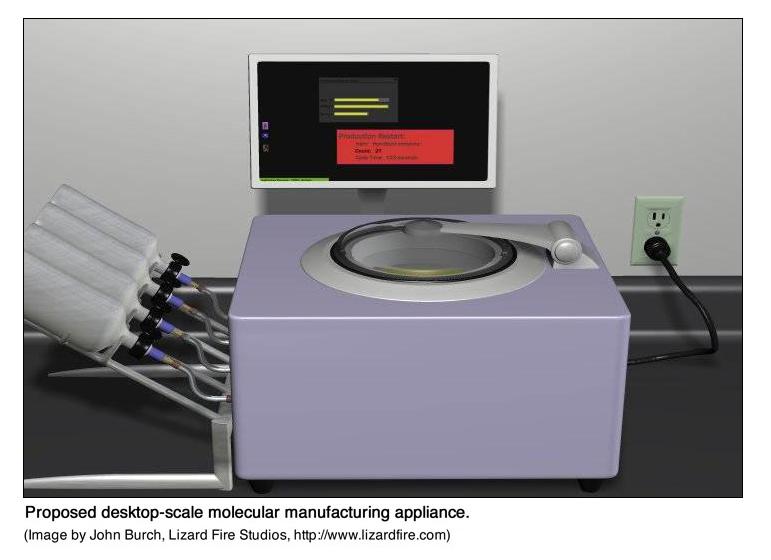
Now nanotechnology can be encapsulated in an apparently simple device called a personal nanofactory that may sit on your desktop. Packed with miniature chemical processors, computing, and robotics, it will produce a wide-range of items quickly, cleanly, and inexpensively, building products directly from blueprints.
To build a nanofactory, you need to start with a working fabricator, a nanoscale device that can combine individual molecules into useful shapes. A fabricator could build a very small nanofactory, which could build another one twice as big, and so on. Within a period of weeks, you have a personal desktop model. Products made by a nanofactory will be assembled from nanoblocks, which will be fabricated within the nanofactory. The product that comes out of the nanofactory will be a mostly-solid block or brick that will unfold like a pop-up book or inflate like an air mattress. Computer aided design (CAD) programs will make it possible to create state-of-the-art products simply by specifying a pattern of predesigned nanoblocks. The question of when we will see a flood of MNT products boils down to the question of how quickly the first fabricator can be designed and built.
A personal nanofactory will consist of trillions of fabricators, and could only be built by another nanofactory. But a fabricator could build a very small nanofactory, with just a few fabricators in it. A smaller nanofactory could build a bigger one, and so on. Most of the mass of a nanofactory is in the form of working fabricators, and according to the best estimates we have today, a fabricator could make its own mass in just a few hours. So a nanofactory could make another one twice as big in just a few days—maybe less than a day. Do that about sixty times, and you have a tabletop model.
Inside the personal nanofactory, each fabricator will make nanoblocks. A good size for a nanoblock might be a cube 200 nanometers on a side (the distance your fingernails grow in three minutes). This is small enough to be made by a single fabricator in a few hours, but large enough to contain a small CPU, a microwatt of motors or generators, or a fabricator system flexible enough to duplicate itself if given the right commands. In other words, each fabricator could make a substantial piece of nanofactory functionality—and the same modular pieces would be re-used in other products.
More >>>