
Purdue University researchers have created magnetically responsive gold nanostars that may offer a new approach to biomedical imaging.
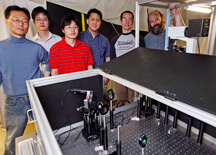
Research team members stand with equipment used for gyromagnetic imaging of gold nanostars.
The nanostars gyrate when exposed to a rotating magnetic field and can scatter light to produce a pulsating or "twinkling" effect. This twinkling allows them to stand out more clearly from noisy backgrounds like those found in biological tissue. Alexander Wei, a professor of chemistry, and Kenneth Ritchie, an associate professor of physics, led the team that created the new gyromagnetic imaging method.
Research team members stand with equipment used for gyromagnetic imaging of gold nanostars.
The nanostars gyrate when exposed to a rotating magnetic field and can scatter light to produce a pulsating or "twinkling" effect. This twinkling allows them to stand out more clearly from noisy backgrounds like those found in biological tissue. Alexander Wei, a professor of chemistry, and Kenneth Ritchie, an associate professor of physics, led the team that created the new gyromagnetic imaging method.
No comments:
Post a Comment